Why a Licensed Engineer

Three bids. Three different repair plans. Three very different prices. If that sounds familiar, you don’t need another opinion — you need an analysis. A Texas-licensed Professional Engineer provides an objective, data-driven evaluation of what your foundation is actually doing, and what, if anything, it actually needs.

Foundation evaluations follow three defined levels of investigation. Level B is our standard — here’s how the levels compare.

Our foundation evaluations are conducted in general accordance with the protocols prescribed in the Guidelines for the Evaluation and Repair of Residential Foundations (Version 3, adopted March 2022, Texas Section of American Society of Civil Engineers) .

Level A • Visual Screening • $

First Impressions

  • Availability: By request — not offered on the online scheduler.
  • Best for: Routine maintenance checks, or deciding whether more investigation is needed.
  • Deliverable: Report of First Impressions based on levels of observable distress.
  • Limits: No elevation measurements or analysis. May not capture true foundation condition (especially if cosmetic repairs have been made). Insufficient to evaluate foundation performance or inform repair planning.
Level C • Invasive Analysis • $$$$+

The Litigation Standard

  • Availability: By request — every Level C begins with a Level B, which determines what additional testing, if any, is warranted.
  • Best for: Lawsuits, complex insurance claims, or high-uncertainty cases.
  • Deliverable: Everything in Level B + additional testing as appropriate (often intrusive): soil sampling/testing, plumbing testing, material testing, and specialty surveys.

A Level B evaluation is our standard offering and what most homes need — it is the only service listed on the online scheduler. Level A and Level C evaluations are available by request, and every Level C begins with a Level B, which determines what additional invasive or testing services, if any, would actually help.
Our process

Level B
Level A
Review of Structure, Site & History
  • Interview, document review, structure & site observations
Distress Observations and Classification
  • Review of interior & exterior distress (e.g., cracks, separations, door issues)
  • Classification of relative degree of interior, exterior, and foundation distress
Foundation Elevations and Analysis
  • Draft scaled first-floor plan to support analysis
  • Foundation elevation survey to capture performance profile
  • Engineering analysis (deflection + tilt)
Conclusions
  • Performance opinion
  • Repair recommendations

Level A includes the first two steps (history + distress observations). Level B includes everything in Level A plus a foundation elevation survey and engineering analysis. Where structural repair is recommended, the report identifies the area of the foundation to be underpinned and an estimated total pier count; detailed pier layouts are developed by the repair contractor and the design Engineer of Record.

What a Level B analysis looks like

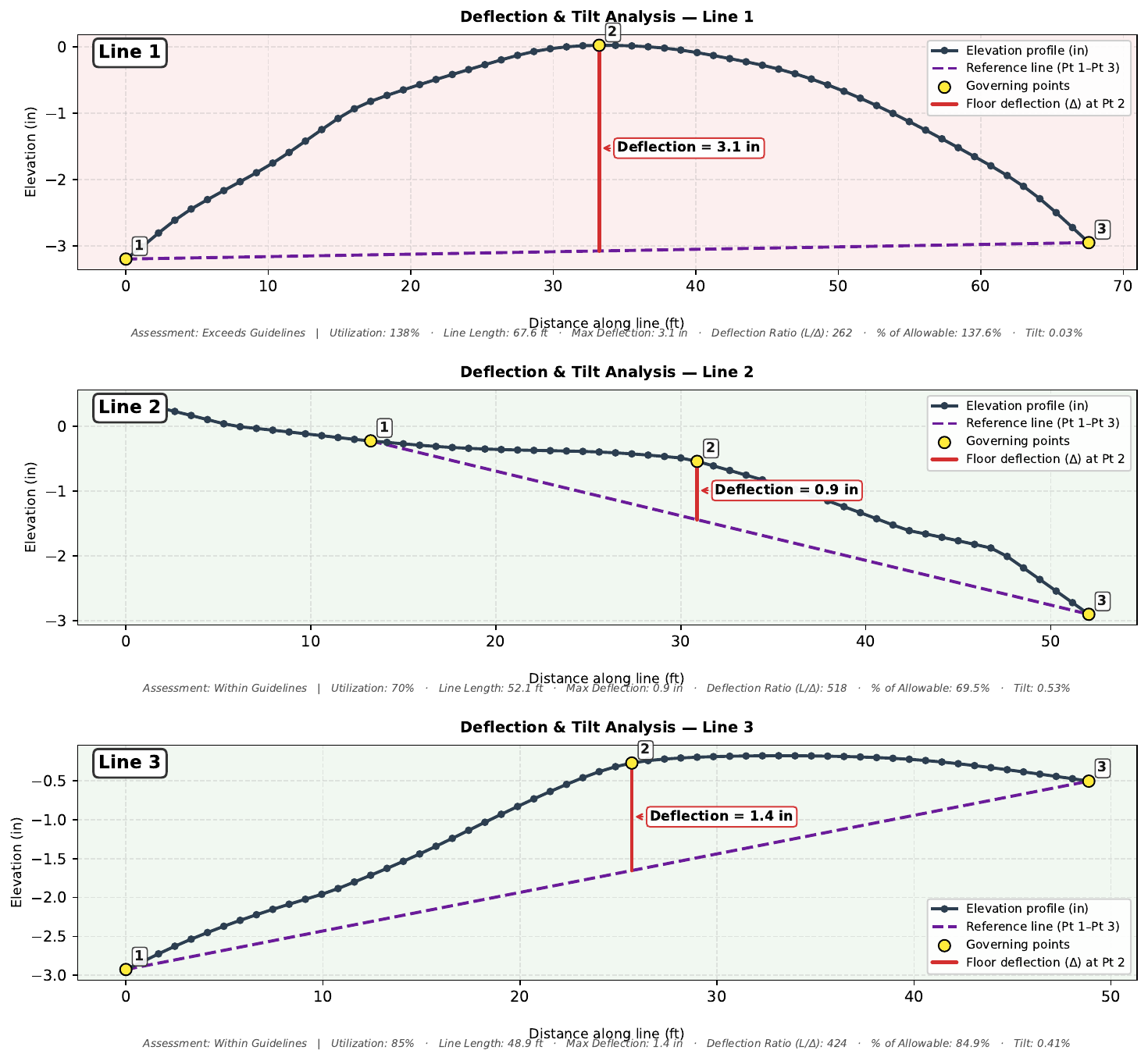
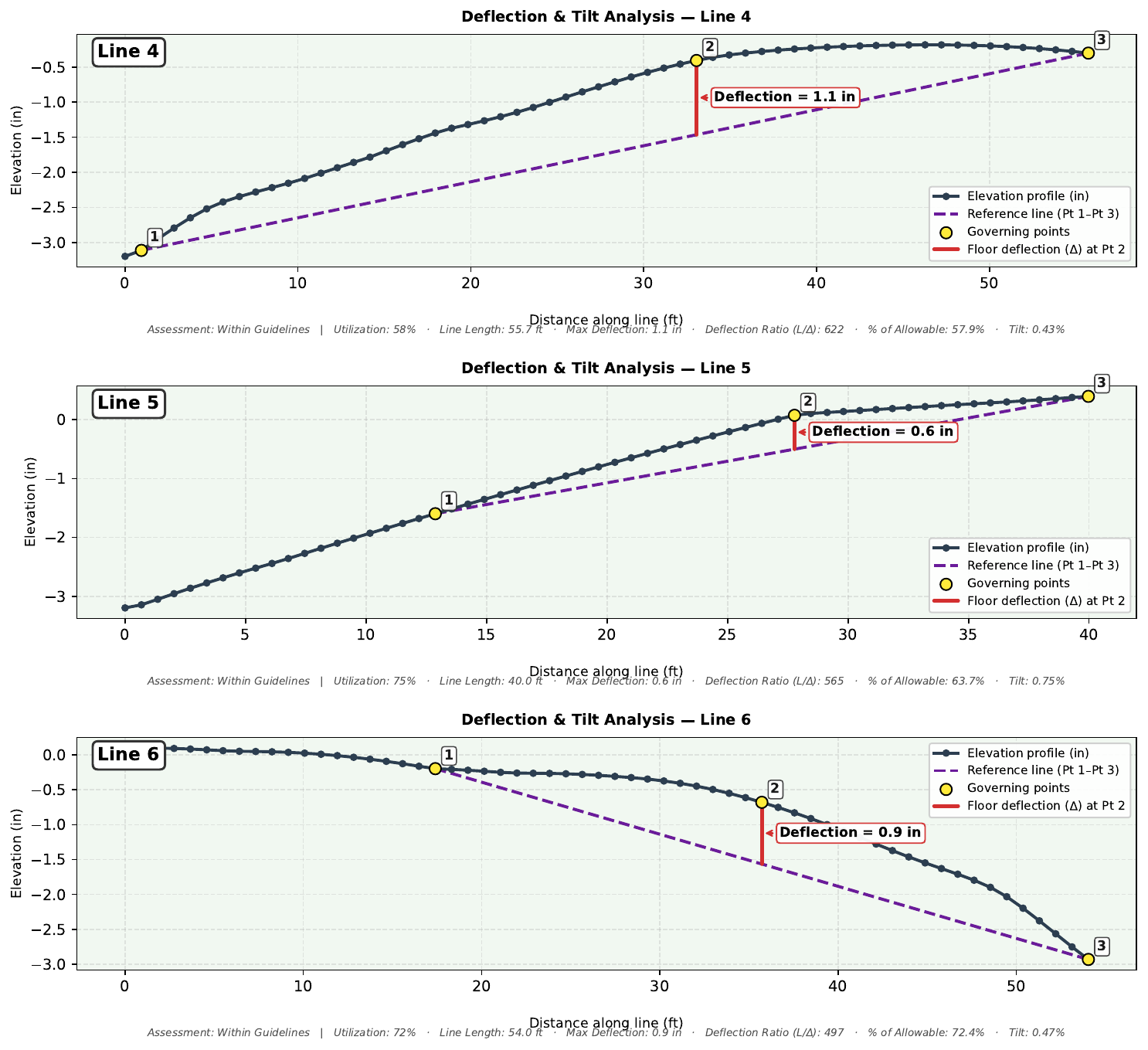
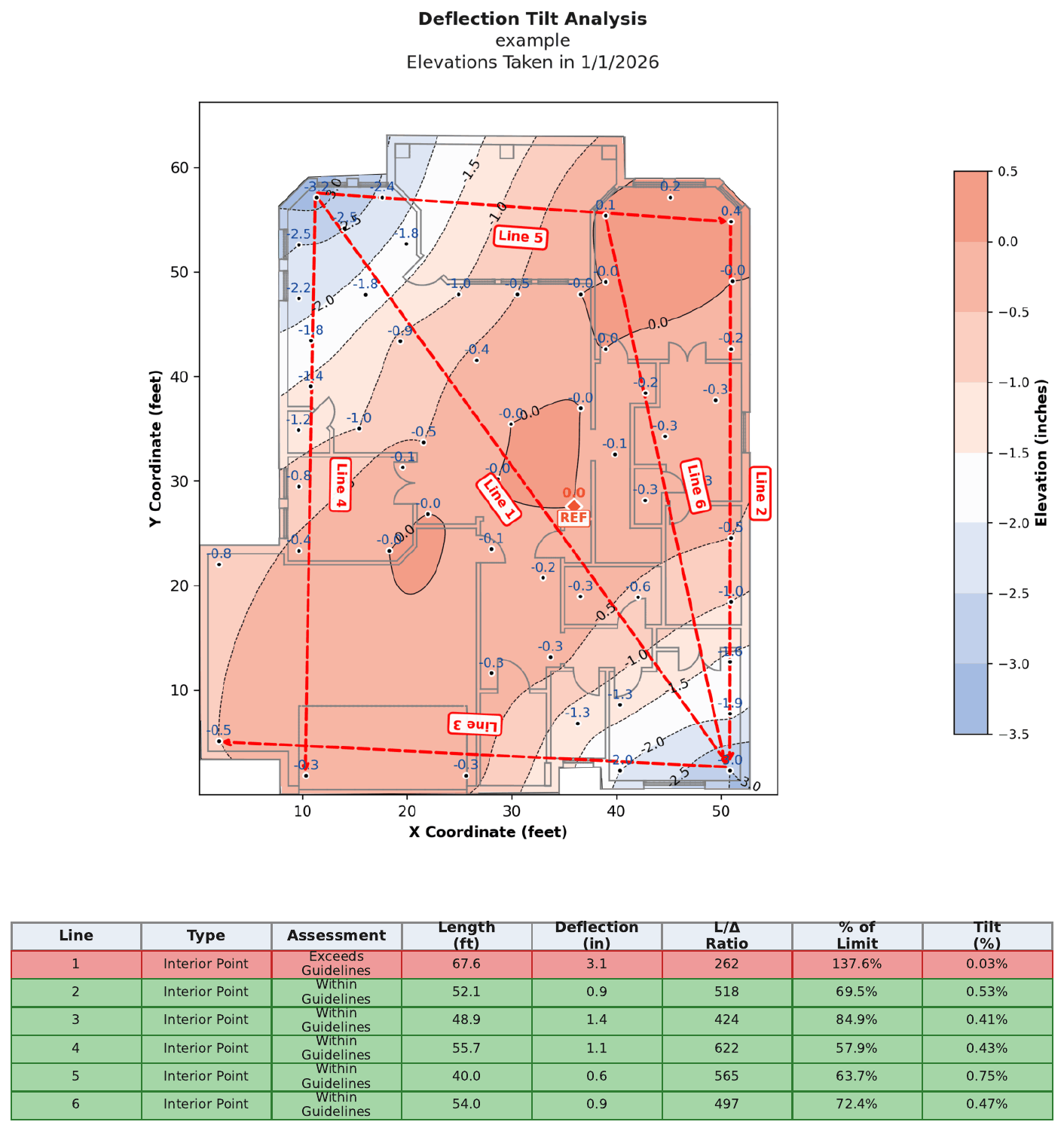
Every Level B evaluation produces a measured, quantitative analysis — generated by analysis software developed in-house by our engineers. Click any image to enlarge.

Example analysis output, shown for illustration only — not representative of any specific property.

What is L/360?

A deflection ratio — the span divided by 360. It’s the same limit the residential building code applies to floor framing, and the reference the ASCE Texas Section guidelines use for foundation deflection. Below 100% of the limit is within the guideline.

What is tilt?

The planar slope of the whole foundation — the slab leaning like a table on uneven ground, distinct from deflection, which is a curve or bow. The guidelines note a tilt greater than 1% is usually noticeable.

What does “exceeds guidelines” mean?

One or more measured lines exceed the deflection or tilt criteria. That does not automatically mean repairs are required — the engineer weighs the full body of evidence, including observed distress. The guidelines themselves note that engineering judgment is required.

Why homeowners choose Criterium-Williams Engineers

Criterium-Williams Engineers is the local (Central Texas) affiliate office for Criterium Engineers. You get the responsiveness of a local engineering firm, supported by the technical depth and shared standards of a nationwide network of building inspection engineers.

Engineer-Only Site Visits

We don’t send technicians or data collectors. The Texas-licensed P.E. who seals the report personally visits the site and performs the evaluation.

Transparent, Straightforward Pricing

Your exact Level B price is calculated instantly in the online scheduler — one all-inclusive fee, no add-on charges.

Objective Opinion, Right-Sized Repairs

Repair scopes and prices vary widely between contractors. Engineering-based recommendations align the scope — so the repair fits what the analysis shows.

What an evaluation may recommend

Underpinning is never the default answer. Every evaluation weighs the full range of possible remedies, and recommendations are tailored to each foundation’s specific conditions. Many homes need only site improvements; structural repair is recommended when the analysis supports it.

No corrective action recommended — sometimes the analysis shows the foundation is performing acceptably. When that’s the answer, that’s the report.

Site Improvements

Addressing the cause of movement

Moisture Management (increase soil moisture)When movement is associated with expansive soils drying and shrinking — watering programs, ground cover, vegetation and root management, irrigation adjustments.
Drainage Improvements (reduce excess moisture)When excessive moisture is contributing to soil expansion — gutters and downspouts, grading, swales, French and area drains, subsurface drainage.

Soil Treatments

Modifying the supporting soils

Soil Stabilization InjectionsInjection treatment of underlying expansive soils to limit additional heave.

Structural Repairs

Restoring foundation performance

Slab Foundation StabilizationWhen slab-on-grade performance is no longer satisfactory — partial or full underpinning, tailored to the observed movement and structural response.
Foam InjectionPolyurethane foam injection for supplemental slab support and void filling.
Pier & Beam Foundation RepairSelective replacement or adjustment of support components — re-leveling, new piers, beam and joist repairs, shims, footings, and connections.

Need clarity before you repair, buy, or sell?

Start with an objective engineering evaluation to support informed decisions.